With sponsor fatigue, spiralling costs and commercial competition posing
an existential threat to association meetings, one question is becoming
increasingly salient: can conferences really leave a long-term legacy? Or
are they just fleeting moments of connection and content?
In the face of growing delegate apathy, association leaders
are grappling to define the value proposition of their events, and many are
turning to the idea that conferences can and should have a lasting positive impact
that extends beyond the walls of the convention centre.
One line of thinking is that the younger cohort of delegates
would be more inspired to attend conferences if they felt that in doing so they
were helping to tackle real world problems.
Now an event held 11 years ago is offering more evidence
that the benefits of conferences can ripple outwards for years, even decades,
after the closing ceremony.
In 2014, the 6th IUCN World Parks Congress brought 6,000 delegates
to Sydney, from all over the world. Organised by professional congress
organiser ICMS Australasia and secured by convention bureau BESydney, the event
gathered conservationists, Indigenous leaders, policymakers, and donors in a
collective effort to shape the future of protected areas.
The result was the Promise of Sydney, an
international plan to strengthen biodiversity conservation through community
empowerment, traditional knowledge, and sustainable funding models. A decade
later, its impact is still unfolding.
One outcome is the enhancement of protection efforts for the
Great Barrier Reef through the integration of Indigenous ecological knowledge.
In Namibia, community conservancies born from discussions held at the conference are now empowering local populations to manage - and benefit from - wildlife conservation.
Meanwhile, Costa Rica has scaled up its Payment for Ecosystems Services
initiative, incentivising landowners to preserve natural forests and
biodiversity.
"The long game is about planning for future outcomes—future
hopes—and that has to be part of the pre-planning phase,” said Emma Bowyer, CEO
of ICMS Australasia. “What we create can lead to greater long-term outcomes,
often many years later.”
A more recent example of legacy takes us back to Melbourne, 2023.
The 26th Congress and General Assembly of the International
Union of Crystallography, also managed by ICMS Australasia, brought together
global scientists and students for a week of discovery and engagement. Beyond
lectures and papers, the congress featured a Guinness World Record attempt: the
world’s largest diamond crystal model, built by 500 school children.
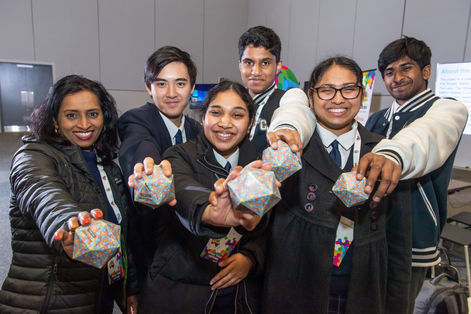 School children received crystals to help spur interest in STEM subjects Photo Credit: Union of Crystallography
This month, 750 diamond crystal kits used during the event
are being distributed to regional and remote schools across Australia and New
Zealand. The initiative aims to ignite interest in STEM education among
students far removed from the halls of academic institutions. From Alice
Springs to the Chatham Islands, schools are eagerly awaiting kits that offer
hands-on learning and a tangible connection to global science.
These stories are far from isolated anecdotes—they represent
a growing movement in the international association sector. According to the Purpose
Under Pressure: Global Association Trends in 2025 report by BestCities
Global Alliance and Strategic Membership Solutions, 70 per cent of association
leaders now rate creating long-term impact—whether environmental, societal, or
policy-driven—as “extremely important.”
“The model is changing fast,” said report author Belinda
Moore. “Associations still value in-person connection, but financial strain and
changing delegate expectations are forcing them to rethink not just how
they meet, but why they meet.”
Legacy, not location, is emerging as the new currency of
value.
Fancy venues and attendance figures are being replaced by
curated experiences, community engagement, and partnerships that extend far
beyond the closing ceremony. As destinations and associations co-create
purpose-driven outcomes, long-term impact is no longer a “nice to have”—it’s fast
becoming a strategic imperative.
Industry advocacy group The Iceberg has taken the
conversation a step further, launching “Iceberg 2.0”—an international movement to
engage policymakers and elevate the recognition of business events as
instruments of societal progress. It's 'Many voices, One Message' campaign aims to corral an army of business events advocates - from scientists, doctors, engineers, business leaders - in cities around the world who can exert influence in the corridors of power.
Chair Gary Grimmer was succinct in his appraisal: “Any city that’s not using
events as a strategy for their social advancement is a city that is missing
out.”
The case studies from Sydney and Melbourne show that when
meetings are designed with intention and legacy in mind, their benefits can
extend across continents and generations. The business events industry, long
seen as a driver of economic activity, is now proving itself as a force for
long-lasting, positive change.
Written By
James Lancaster
AMI editor James
Lancaster is a familiar face in the meetings industry and international
association community. Since joining AMI in 2010, he has gained a reputation
for asking difficult questions and getting lost in convention centres. Proofer, podcaster, and panellist - in his spare time, James likes to walk,
read, listen to music, and drink beer.