City tourism across Europe is shifting gears, facing
mounting climate concerns and geopolitical instability, according to the recently
released City Travel Report 2024/2025 by CityDNA.
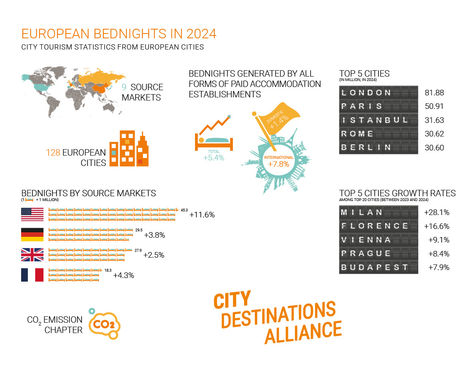 Photo Credit: Supplied
The annual CityDNA report revealed that average bed-night
growth in European cities slowed to 5.8 per cent in 2024, down from 13.7 per
cent in 2023. This decline signals towards urban tourism no longer rebounding
but ‘recalibrating’, according to the report.
“Growth is no longer the only metric,” said Barbara
Jamison-Woods, president of City Destinations Alliance. "City destinations are
now called upon to define success in terms of value, sustainability, and shared
prosperity."
While the report confirmed the continued dominance of London, Paris, and Istanbul in terms of total bed nights, the dynamics are evolving with Milan (+28.1%), Florence (+16.6%), and Vienna (+9.1%) posting the most notable increases among the top 20 cities. Overall, 107 of the 128 cities analysed experienced growth.
The report tracks data from 128 cities and shows that urban centres are lagging behind national tourism. International bed nights grew by 12.2 per cent in EU nations and the UK, compared to just 7.9 per cent in cities. Total bed night volumes expanded faster in other regions (7.6%) than in cities (5.2%), pointing to a need for strategic rebalancing.
Yet behind this optimistic rebranding lies a complex picture. The report highlighted that transport-related CO2 emissions from tourist travel to cities increased by 3.3 per cent in 2024. Only 13 of 59 cities were able to reduce per-tourist CO2 levels, suggesting a mismatch between sustainability goals and travel realities.
City tourism’s dominance is being challenged not only by
environmental strains but also by global instability. The report lists 'continued geopolitical instability, inflation, and mounting climate concerns' as key pressures facing European destinations.
"City tourism remains the most dynamic segment of the
tourism economy, but it must now compete on the basis of resilience and
innovation," said professor Karl Wöber of Modul University Vienna. He warned
that cities face "emerging structural challenges that demand sophisticated
destination management and long-term planning."