More than hundred association executives gathered in
Florence recently to learn from each other and ponder some of the major
challenges facing their organisations – from revenue generation to climate
change to the rapid advance of Artificial Intelligence.
The occasion was the 10th edition of Associations
World Congress, an event which not only survived a pandemic-enforced hiatus but
emerged from it rejuvenated. The current iteration of AWC is a more focused,
streamlined affair than years gone by.
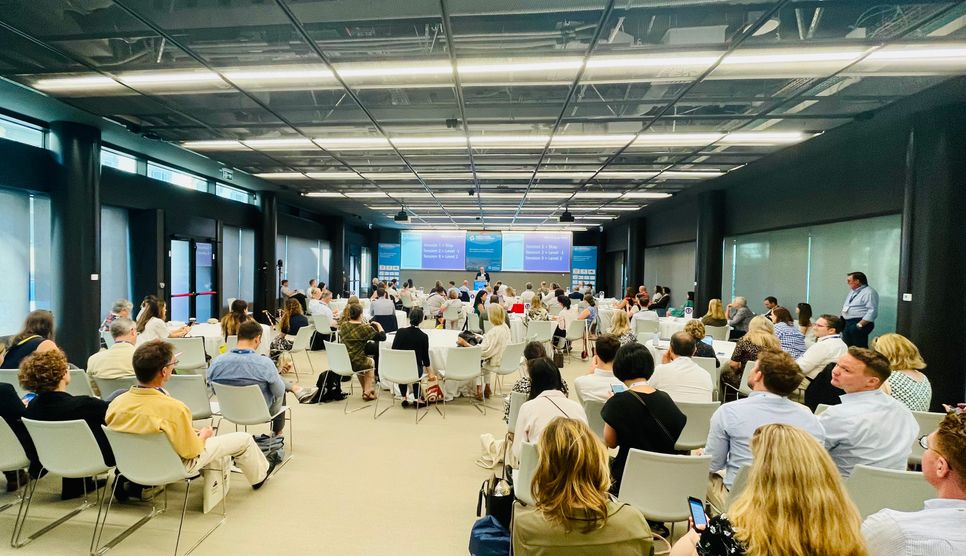 Full house at the Palazzo degli Affari Photo Credit: James Lancaster
Carrying on from where it left off in Lisbon in 2022, this
year’s three-day programme was not designed to overwhelm. Instead, organisers
AAE (the Association of Association Executives) stuck firmly to the much-neglected
principle that less is more.
Broken into three tracks covering Association Strategy,
Conference and Events Strategy, and Executive Skills, each session covered an
entire morning or afternoon, allowing delegates to explore subjects in greater
depth than is typical for events like these.
There’s another interesting aspect to this: AWC delegates are
expected to be engaged in the sessions, to ‘show up’. To ensure that
happens they must choose which sessions they want to attend before arriving at
the event and do their homework – literally.
Before arriving, they are asked to submit contributions
(‘input’) to their chosen sessions (opinions, data, overview of experience etc)
and provide at least two mini case-studies, which they might be asked to
present to their peers during the congress.
Given how time poor we are, it’s a risky strategy, but one
which pays off. I don’t see much smartphone gazing during sessions.
“One thing we realised coming out of the pandemic was that
we didn’t want to produce something that delegates could experience online,
hence the level of preparation," said AAE executive director Damian Hutt. “But
it’s worth it.”
So, what did we learn?
Well, things are tough out there. In general terms things
have ‘recovered’ since the pandemic, but not fully, and the industries and
institutions that support associations, be they trade or individual member, exercise
more caution in terms of how they spend their money. Inflation is having
an impact. But other factors are now coming into play. One association
executive told me a company member who used to send several delegates to their
event now only sent one due to carbon travel budgets.
And what of meetings and events themselves? In an excellent post-congress
blog
post attendee James Whitaker, senior young member programs manager at the Society
of Petroleum Engineers International, summed up the challenge facing
associations.
“On a fundamental level we have all
changed since Covid. And while there is a nostalgia in how things used to be,
when industry professionals think about pushing their career and industry
development, they want to be ahead of the curve, not looking back. Our events and activities must reflect this to
show we will help our members through these uncertain times. It is no longer
enough to provide technical content and hope that attendees have a nice time
while they are with us. We have to ensure that we are providing those experiences and
opportunities, on top of a useful and applicable programme.”
What 'useful and applicable' looks like will vary from one association to another. But there was a consensus among delegates that claiming to be the 'voice of the community' will no longer cut it. Associations have to prove they have their finger on the pulse. Attendees want more control over meeting agendas, more engaging content, and no longer look up to 'The Gods on the Board'.
Associations World Congress took place at the Palazzo degli Affari, July 9-11.
Written By
James Lancaster
AMI editor James
Lancaster is a familiar face in the meetings industry and international
association community. Since joining AMI in 2010, he has gained a reputation
for asking difficult questions and getting lost in convention centres. Proofer, podcaster, and panellist - in his spare time, James likes to walk,
read, listen to music, and drink beer.