
“Don't sweat the stuff you can't control…"
Tracy Bury, Interim CEO of World Physiotherapy and a familiar face in the meetings industry, has been sharing insights with her peers…


JL Last year you launched your own association consultancy, Operandi Consulting. What inspired you to go solo, as it were, and what’s it been like dispensing your wisdom?
TB I was ready for something new! It no longer felt scary to walk away from something that I'd known for so long, and felt comfortable and happy with, and to think that something else could also bring joy, for want of a better description. I love working with people and just felt there was an opportunity to bring all of those things together in a different way and to add value.
JL And has it worked out? Have you been busy?
TB Yes, I've been fortunate in that I had people coming straight to me and I think that's the value of having developed your networks in advance, but also nurtured them because you're never quite sure what the future holds. Somebody once described it to me a bit like gardening: you need to tend to your networks and then it pays back. So, I've been busy enough, which is what I was looking for, and it's also been varied which is what I was hoping for. I've been doing projects that have included strategic planning, governance and leadership development, organisational reviews and a bit of coaching as well.
JL What kind of organisations have approached you?
TB European and international associations, as well as destinations. Some associations are in the health sector, which is probably the sector I know most, but they're coming from others as well, and that's the pay-off from attending things like the Association World Forums or other association days at IBTM or IMEX.
JL I want to come back to that overlap between the meetings industry and the association world, but let’s go back in time a bit. You’re actually a trained physiotherapist. How did you get into the association world?
TB I never saw myself as entering the association world when I joined the Chartered Society of Physiotherapy in the UK. I was a practising physiotherapy clinician. The driver then was wanting to be somebody who was involved in change rather than complaining about it. You know, how can you be a part of making things better? And then a job was advertised at the society and I was really interested in working at a national level. There were new and emerging areas around research capacity development in the profession. I applied not thinking I'd get it because I didn't feel I had enough experience, but somebody saw something in me, and the rest is history.
JL The meetings sector often thinks horizontally rather than vertically about the association world, they talk about ‘association professionals’. Whereas a lot of association people just think of themselves as a professional in their field…
TB The role or the job of an association executive is viewed differently in Europe compared to the States, where it’s a respected profession and you have a career pathway. I don't think that exists in Europe. Here there can still be a disconnect between governance and leadership, with some volunteer leaders saying to staff, ‘you don't know our world. You're not specialist in our area’. There’s sometimes a lack of respect or recognition for management leaders. You know there is such a thing as evidence-based management, there's research and science behind it!
JL What in your view are the main challenges for associations?
TB Environmental, social, and governance, or ESG, and the risk-taking around that. We talk about calculated risk-taking in risk management terms, but when I speak to people it still seems that non-risk taking is the default association position. There are also challenges around governance capabilities, a real need for leadership development, that becomes more pressing when we think about the ‘G’ challenges of ESG. There are also issues around staff retention and recruitment, succession planning, both internally and within the volunteer leadership side of things associated with the ESG agenda.
There are also issues around geopolitical disruption: war, conflict, natural disasters, pandemics, but also what's playing out in national politics having international repercussions. Associations are generally apolitical, but they operate in a political context and increasingly that's coming into play. Finally, I think there are challenges around how we prepare organisations for change.. How do we get a change of organisational culture that embraces change in itself? And one that does that in a timely way when we know the wheels of associations can turn slowly.
“Associations are generally apolitical, but they operate in a political context and increasingly that's coming into play..."
JL Are associations coming under more pressure to take a political stand on things? I'm thinking about some of the associations in America who have come out and said they're going to boycott certain states for various reasons…
TB The pressure is building on lots of levels. We've seen it around the Gaza-Israel situation and whether people should be calling for ceasefires and is that the role of associations or not, and around, as you say, the state-by-state issues in the US. Inevitably when you get membership-based organisations you get member voices and not everybody's going to agree all of the time. It’s a question of how you facilitate the dialogue, because where is ‘right’ in all of that is not always clear, and there are times to make statements and other times to listen, reflect and act in other ways.
JL Do associations have the skillset to deal with all this?
TB The piece that is sometimes challenging is how you educate, because we're all learning, and we're afraid of getting it wrong. Who's going to stick their head above the parapet and say something because they're worried about being shot down? Clauses included in statements could come in handy here! So, a statement could go something like, ‘this is a continually evolving situation. We continue to learn and will adapt on the basis of feedback’. Then you're saying to everybody you're a listening, learning, growing organisation that's not afraid to say if it needs to change things.
JL It's easy for these issues to be seen through a European or North American lens, because that's where the association is headquartered. But I was reading a piece in the paper the other day about the last person in the UK to be prosecuted for being gay, and it was in a military scenario, the Royal Navy, and that was in 1994! So you start to think, well, it's a sliding scale!
TB True and when you're talking about EDI there are so many components beyond the obvious ones, and there will always be ones you're getting wrong, depending on who is looking at it and from where. We all have so many biases and assumptions that we may not be aware of, and change takes time. So yes, it's complex! How do we use our humanity to listen and try to be understanding and be receptive to different perspectives?
JL What makes your story interesting is that you're a familiar face in the meetings industry and the association world and the nature of that relationship is fascinating. Some people are working hard to make it more mutually beneficial, less transactional, to elevate the conversation, but it is still a small world, isn't it? Why do you think that is?
TB One of the challenges when you talk about associations is they're not all the same. Some of them are volunteer-led, they don't have any employed staff at all. So, who's engaging in those conversations? We can't put pressure on associations, when so many are volunteered driven. But the critical thing is to take what I call an eco-systems approach. It's amazing if you’ve ever spent the time - and I did this with our board at World Physiotherapy - to map out your internal and external ecosystem around events. You get to see just how complex it is! There’s fantastic storytelling being captured by The Iceberg, Meet4Impact, BestCities and others, but what I'm not hearing is the storytelling coming from governments and other stakeholders. Until we change that dialogue to the bigger ecosystem, I think it's still going to be a struggle…
“How do we use our humanity to listen and try to be understanding and be receptive to different perspectives?"

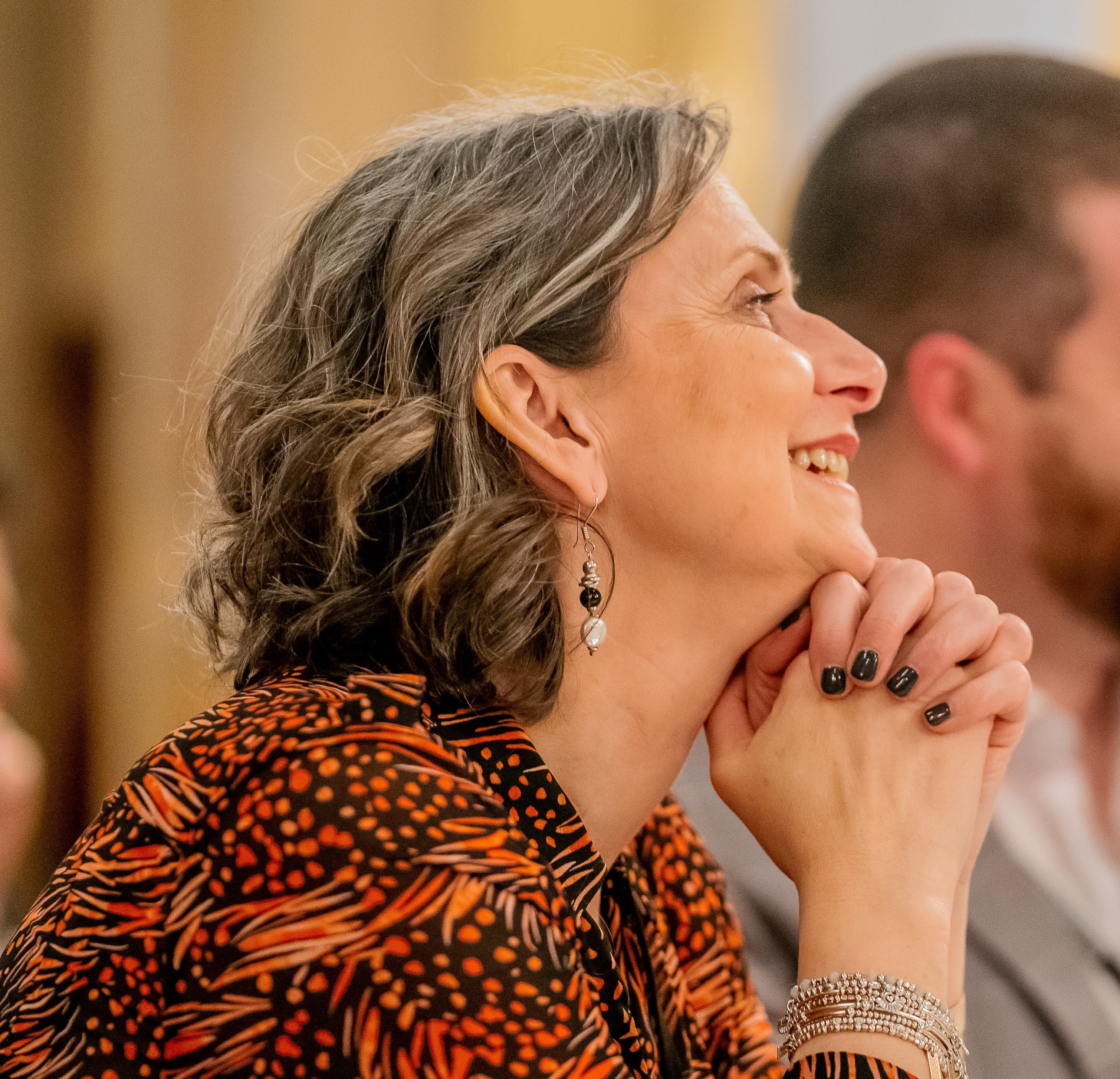
The networking reception can feel daunting, but be intentional if you can, if there are three people you want to meet, home in on them. And if that's job done, leave the room. Don't feel you've got to stay...
JL Some people in the sector have raised the issue of the meetings industry’s ‘license to operate’, with cities rejecting tourism, and maybe even business tourism, for ecological reasons. Do you sense that the meetings industry holds up association meetings, and the value they bring to society, as the poster child to justify its existence?
TB I'm not sure whether it's specific to associations or whether it's corporates, as well, and the kind of consumers you are bringing into a market. All have the potential to create value and impact. But we must be careful about beating up meetings because of climate! This week there was something around bio-fuel developments, an airline flying on poo! So, we need to be careful not to risk holding back an industry, like the events sector, while there is evolution happening in another, such as aviation, that could eventually negate a significant environmental impact. If there’s a question of accreditation versus regulation, I’d go for the former. I worry that over regulation will constrain innovation or not keep pace with it.
JL Are associations doing enough to communicate the benefits of their meetings, not just externally, but to their own members?
TB They are getting better and in part that comes back to member voice and generalised society concerns around climate and sustainability, but also about the value of the activities that associations do, where is the impact? So, part of that holding to account is being openly accountable and reporting. It's more overt than it would have been in the past, probably still room for improvement, and, again, it varies from one association to another.
JL What advice would you give yourself if you could go back in time?
TB Don't sweat the stuff you can't control. Focus on the things you're in control of, or you have influence over, because it’s the other stuff that gets you stressed. It stresses you usually because you care but it helps to think about your circles of control.
JL You’re obviously a people person, but a lot of people don't like going into a room full of strangers and may feel as though their reticence is holding their career back in some way. What advice would you give to people who struggle with it?
TB That's an interesting question because on my desk at the moment is the book Quiet by Susan Cain. Are you an introvert or extrovert? I think I'm an ambivert. I can go between the two. Networking isn't always about loud voices or ‘being in the room’. You can set up one-to-ones. The networking reception can feel daunting, but be intentional if you can, if there are three people you want to meet, home in on them. And if that's job done, leave the room. Don't feel you've got to stay.
 Built with Shorthand