
Death by dignitary
Why conferences start with a whimper
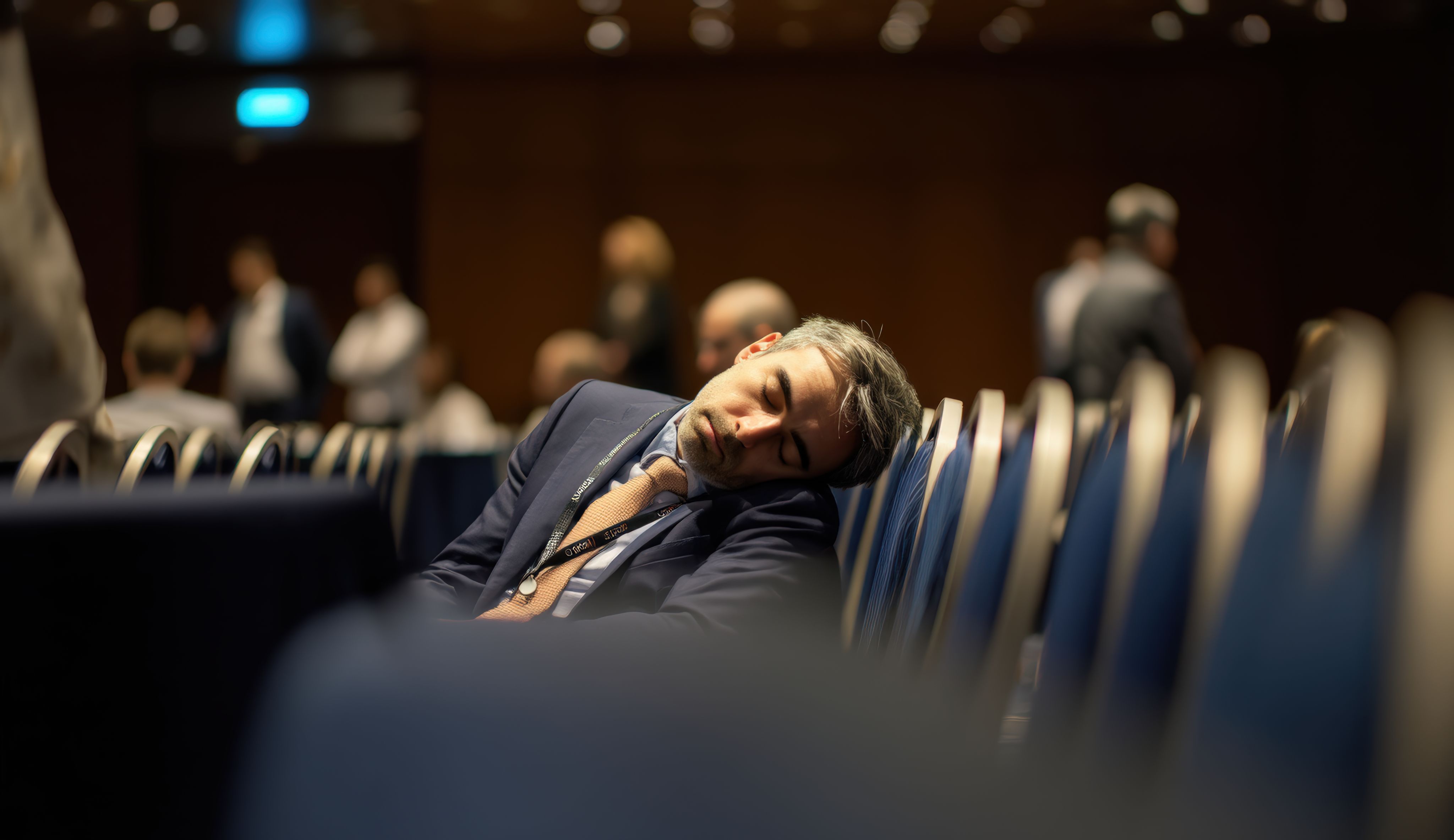

The deputy minister for tourism and economic development was the third or fourth man in a navy suit to walk onto the stage and stand behind the lectern. The hesitant applause that greeted him sounded like despair. Those sitting nearest the stage noticed the sheaf of papers in the minister’s left hand, tried to gauge from its thickness how long his speech might last. Under cover of darkness, some of the delegates in Tiers 1 and 2 were making their apology-strewn escapes. Others, more senior, had decided to lean into their boredom by taking a nap. When the minister spoke it was to thank everyone who had already been profusely thanked and to welcome everyone who had already been profusely welcomed. And then, for the avoidance of doubt, he reiterated how the conference aligned with the city’s 2030 vision, and why events like these mattered. The words tumbled from his mouth like dead flies. He was speaking about things of which he knew very little and of which he cared even less. His mind wandered ... soon he would be out of here ... home ... a glass of wine ... a shoulder to rest on. When, at last, he had finished what he had to say, he dared a quick glance into the audience. For a moment, he was perplexed. Was this a standing ovation? Alas, no. More a stampede. As he left the stage, the moderator was frantically reminding people where tonight’s reception would be held. Where the coaches would pick … but nobody was paying any attention. The moment was gone.
International conferences can be years in the making. For the associations who organise them, they carry enormous financial, strategic, and - let’s not be coy - emotional weight. Amazing then, how often they begin with a collective groan. An elongated sigh of complaint.
These false starts are not accidental.
The reason they persist is that most international conferences are subsidised by the host city, and with that comes an expectation: stage time.
We paid therefore we speak.
The result is an opening ceremony that turns delegates into hostages.
And this indulgence doesn’t stop once the conference is officially open. In the worst cases, it’s a running theme. Every plenary ‘supported by’ someone who must address the room. Every sponsored lunch preceded by a little speech. Networking drinks that grind to a halt while the organiser thanks the sponsors, the sponsors thank the organiser, and everyone else thanks their lucky stars they’re already half drunk. This is not engagement, it’s endurance.
Acknowledging someone’s support by handing them a microphone and letting them waffle on creates a stifling surfeit of politesse ...


Who else would tolerate this level of self-sabotage?
Imagine a product launch for Apple or Nike where the first hour was spent thanking the venue, the caterer and the electricity supplier. Yet at conferences this is normal.
The subsidy question sits uncomfortably at the centre of it all.
When local hosts contribute significant funding, they are often given disproportionate influence over the programme. The rule, unspoken, but always contractual, is clear: money in exchange for visibility.
But visibility shouldn't have to mean boredom. Acknowledging someone’s support by handing them a microphone and letting them waffle on ad tedium just creates a stifling surfeit of politesse. It is a failure of imagination, to be blunt.
Creative event organisers know this. They know that forcing people to listen to speeches serves no one –not the organisers, not the dignitaries themselves, and certainly not the delegates.
There are better ways.
If local leaders or sponsors must be on stage, involve them properly. Put them into a moderated - not scripted! - discussion about real issues. Have them respond to challenges, not recite slogans. Get them to interact with the audience. Encourage them to be provocative in constructive ways, that add value to the delegate experience.
In their book Meetings by Default or by Design, Mike van der Vijver and Eric de Groot stress the importance of ensuring delegates aren't mere spectators in opening ceremonies, that openings are used to express how organisers want delegates to interact with the content. Opening ceremonies should be about setting expectations of behaviour - but in a fun, engaging way. So, why not allow dignitaries to lead by example? Let them set the tone in the right way.
Otherwise, what are we saying? That we value protocol over people, obligation over experience, and funding over flow. That we are willing to squander the most emotionally charged moments of an event to satisfy a transactional arrangement.
If association conferences want to feel relevant, dynamic and human, this nonsense must stop. They must start their conferences with a bang, not with a bureaucratic dirge. Respect the audience’s time. Be braver with the stage. Because no matter how generous the subsidy, boring people to sleep is a terrible return on investment – for everyone.
Until then, you’ll find me in Tier 2.