
How to ...
Stay relevant in a digital world


Imagine you were to start an association today. Would you begin with printed stationery, committees, and in-person meetings? Or would you start online, to connect with like-minded people and make plans together?
The digital transformation offers associations incredible opportunities to reach their goals more effectively, engage members more actively, and increase their impact.
Yet, many associations struggle with the question of how to combine traditional ways of working with modern technologies.
To guide this transformation, the Association Propeller can help.

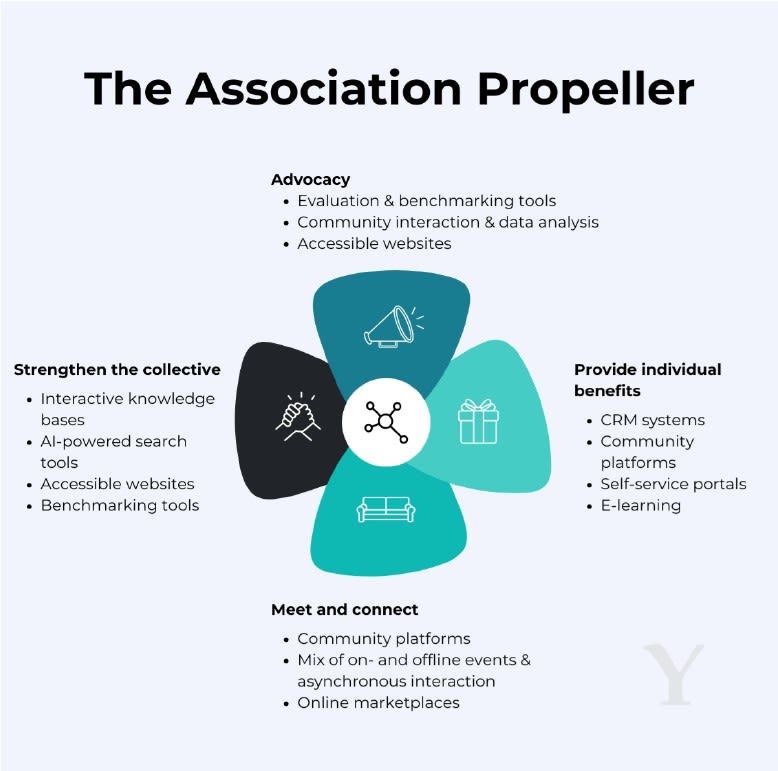
This strategic model maps out the core functions of an association and shows how digital tools can strengthen those functions. By using technology wisely and integrating it into a long-term strategy, an association can increase its relevance and build a sustainable future.
The core functions of an association
The Association Propeller identifies an association’s four key tasks, which determine how it creates value for its members.
- Meet and connect – Bringing members together for interaction, knowledge sharing, networking and matching supply and demand.
- Strengthen the collective – Developing the sector or profession through cooperation and innovation.
- Provide individual benefits – Supporting members with services such as education, discounts, and events.
- Advocacy – Representing the sector’s interests, voice and influencing policy.
For each of these roles, digital tools exist that help associations work more efficiently, effectively, and future-proof.


Meeting and connecting in a digital world
An association lives through its members and the connections they build. Traditionally, this happens through events, conferences, and networking meetups. Today, digital tools play a growing role in strengthening member interaction, both online and offline. New generations are used to online networking.
Which digital tools help connect members?
- Community platforms. Provide a safe, central place for connection, discussions, and knowledge sharing.
- Mix of online and offline events and asynchronous interaction. Combine physical meetups with digital interaction to reach more members.
- Online marketplaces. Support collaboration by connecting supply and demand within the sector.
The power of digital communities
Community platforms are essential for bringing members together under the association’s trusted brand. For example, Vastgoed Nederland (formerly VBO; The Duth association of estate agents) launched the platform 'Connect' to increase member interaction through Q&A sections, knowledge libraries, and online working groups. Members are asking on average 45 questions per month and give 227 answers. Within five months, 90 per cent of members were active on the platform. About 20,000 personalised emails and communications are sent automatically each month to its 1,400 members, reducing communication workload for the association bureau by 30 per cent and increasing member engagement significantly.
In the sports world, the Royal Dutch Football Association (KNVB) launched Een-tweetje, a platform where club board members share experiences and learn from each other (read more about this case here). This was later expanded into the Sports Directors platforms by the Dutch Sports and Olympic Association for other types of sports, improving collaboration across the field and advancing sports in the Netherlands.
Nevi, the association for procurement professionals, created interactive community-driven events called “Unconferences” where members vote on topics beforehand.
Results are shared online afterwards on their community platform.
Online marketplaces: Associations as platforms
Online marketplaces can help associations connect supply and demand in their sector. For example, the Dutch GP Association (LHV) helps members with practice takeovers via Praktijkmatch, and CBM, the associations of furniture makers and interior builders, offers a closed marketplace for materials and staff.


Strengthening the collective through digital knowledge sharing
A strong association doesn’t just help members individually, it also mobilises them to support each other to jointly build up the sector as a whole. This happens in so-called Communities of Practice, in which knowledge sharing, peer learning and collaboration are key. Where social media groups are often scattered and temporary, digital platforms offer structured, safe, and searchable spaces for long-term joint knowledge building.
Which tools support collective knowledge sharing?
- Interactive online knowledge bases and community platforms – Store validated and user-generated knowledge, guidelines, and best practices.
- AI-powered search tools – Help members find the right information quickly.
- Accessible websites – Strengthen the association’s position as a trusted source of information for its sector.
- Benchmarking tools – Compare performance to identify areas for improvement.
In practice: from scattered knowledge to a living database
Effective knowledge sharing requires a central location where members can find and contribute information. TVVL and other technical and construction associations developed KUBR, a platform where professionals share and consult industry knowledge. An AI-powered search tools allow users to navigate the knowledge base easily and ask about additional or missing content, strengthening the sector overall.
Benchmarking tools
Want to (anonymously) compare the characteristics of different companies or organisations? This can be done easily with a benchmarking tool. For instance, the Dutch Association for Associations (DNA) introduced its benchmarking tool to give members insight into how their organisation compares to other associations. This allows them to recognise opportunities and challenges to make sure they develop in a relevant way.


Providing individual benefits through personalised digital services
Members don’t just expect collective advantages — they also want clear, personal value from their membership. An association adds value by offering members practical services such as education, discounts, and job boards.
The digital world enables these offerings to be more accessible and personalised than ever. This helps strengthen members individually and gives them direct value from their membership.
Which digital tools provide more individual membership benefits?
- CRM systems provide insights into member needs and enable personalised services.
- Community platforms tailor interaction and content to member preferences.
- Self-service portals let members see and manage their preferences, activities, and relevant content. Self-service solutions can be useful to automate processes like certification, accreditation, and online exams.
- ELearning, digital training and online academies that support members’ professional development.
In practice: the importance of data for personalisation and relevant services
Personalisation is key to delivering valuable membership. With a CRM system and your community platform, you gain the advantage of using data to provide a personally relevant offering and partially automated, personalised communication. Additionally, an active (online) community helps you stay informed about what matters to your target group, as it collects data on their actions and interactions. This enables your association to offer services that are truly relevant to its members.
Truly community-driven associations develop these services in co-creation with their members.
Self-service portals: digital certification and accreditation
NLActief developed a digital exam portal that allows sports professionals to easily obtain and manage their certifications. This reduces administrative work and makes professional development more accessible.
Another example is the Foundation for the Council of Professional Training for Clinical Neurophysiology Technicians, which introduced an accreditation tool.
This streamlines certification processes and gives professionals a clear overview of their qualifications.


Advocating with data-driven strategies
Associations play a crucial role in representing the interests of their sector. This requires not only strong lobbying, but also reliable data and broad support among members.
Which digital tools support advocacy?
- Evaluation and benchmarking tools – Provide data-driven insights for policy development and identify trends.
- Community interaction and data analysis – Support collaboration, knowledge sharing, and provide insights into members’ needs and concerns.
- Accessible websites – Create a professional image and increase the association’s authority.
In practice: data-driven decision-making
Effective advocacy starts with data, and associations can collect it digitally in various ways:
- Online marketplace platforms: For example, the Dutch Association of Estate Agents (NVM) uses its Funda housing marketplace data to analyse trends and develop policy advice.
- Benchmarking tools: The Dutch Association’s DNA benchmarking tool not only gives members insight into how their organisation compares to other associations, but it also helps the Dutch Association to identify relevant trends in the association sector.
- Online surveys, research and evaluation tools allow you to periodically research a specific target group. Through comprehensive questionnaires, you gain valuable insight into your audience. A good example is the youth website TestJeLeefstijl.nl, developed by the TestJeLeefstijl Foundation, in which young people can fill in a “lifestyle reality check” survey. This foundation aims to be a reliable source of information and advocacy for young people on topics like health, emotions, alcohol, drugs, sexuality, and other issues faced by those aged 12 to 25, and the data collected with an online survey tool helps them to identify trends and develop policy.
- Online community platforms: These facilitate interaction to support advocacy efforts and ensure legitimacy through a highly engaged base of supporters. Fast feedback loops and interactions within online communities ensure relevant advocacy, while platform data provides insights into trends, without needing to ask participants directly.
The core of the Association Propeller: digitally optimising key processes
Besides the four 'blades' of the Association Propeller, the propeller axis represents four organisational processes that can be optimised with digital tools:
- Governing – CRM data and community insights help inform strategic decisions.
- Decision-making – Online general meetings and digital voting increase accessibility and engagement.
- Execution – AI tools and automation support workflows.
- Engagement – Digital communication, online communities and apps actively involve members.
According to the MCI Association Engagement Index 2024, 31 per cent of members want to contribute to their association, but only 15 per cent find it easy to do so.
This shows a major opportunity for associations to boost member engagement through accessible digital tools which proactively invite members to participate.
Remaining future-proof as an association
The Association Propeller helps associations balance digital and physical interaction. By embracing digital innovation and actively involving members by taking a more facilitating role, associations can strengthen their impact and stay relevant in a fast-changing world.


Meet the authors