"Performative collaborations are getting us nowhere ..."


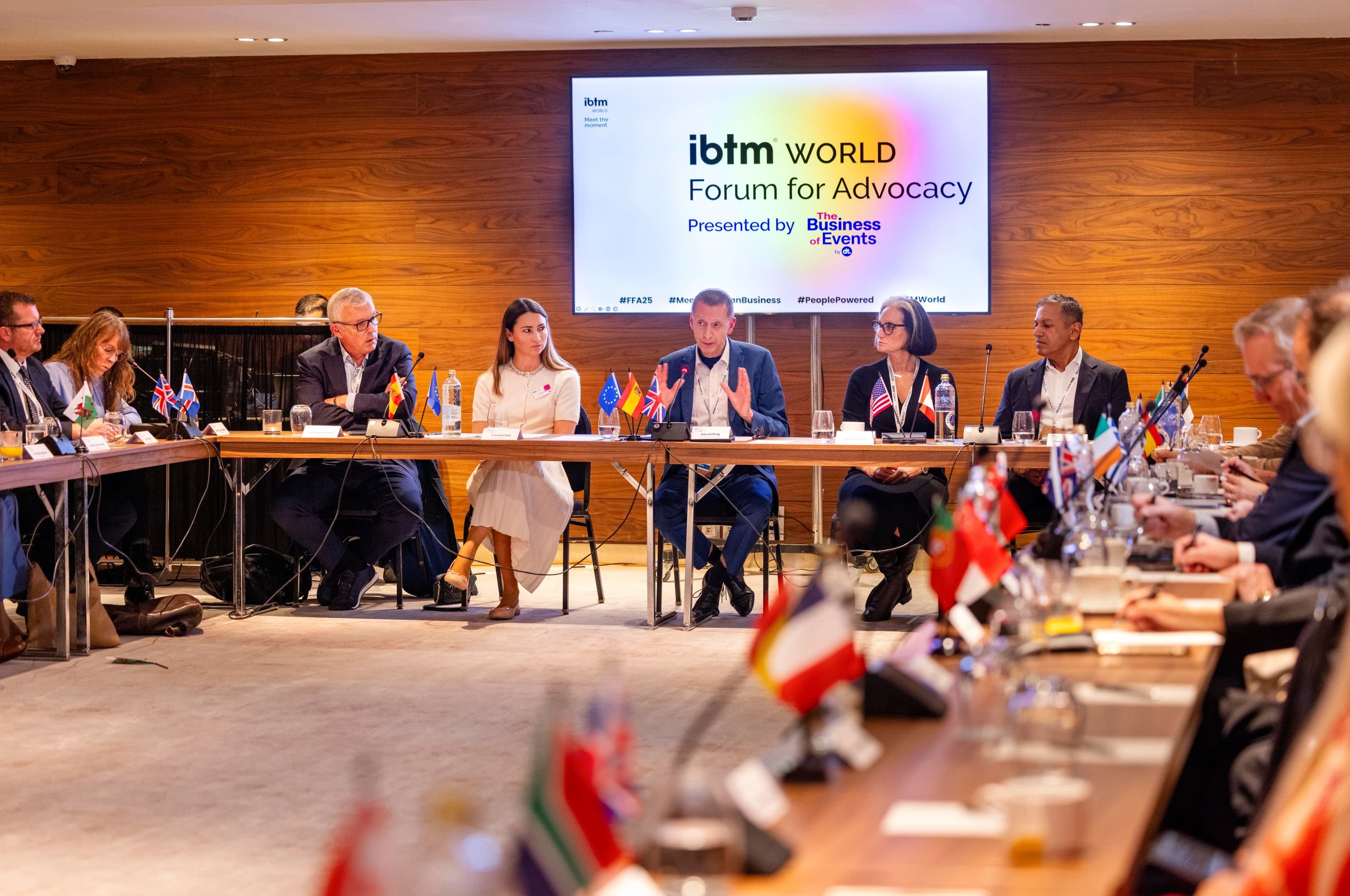
The IBTM World Forum for Advocacy saw event industry leaders meet in Barcelona to - *checks notes* - 'champion global change', 'connect with power players' and make their 'business influence go even further'.
At least that was the sell, and fair enough. After all, what is more likely to inspire selfless commitment to a good cause than the promise of a private powwow with power players?
The optics reflected the new, top-level positioning. No bean bags or campfire pouffes here – this was Strictly Boardroom, with each delegate seated behind their national flag. One attendee told me it looked a bit 'G20'. I, mere member of the media, had to make do with the press release.
So, what happened? What global change was championed?
Alas, not much.
Those involved agreed to, ‘support a collaborative campaign to achieve worldwide recognition for the events industry and its impact on job creation, education and innovation’. Which is pretty much precisely what the industry has been promising to do for the last ten years. Longer.
The upshot was something called the Barcelona Declaration, which would stand as a monument to the industry’s capacity for pompous waffle, if the landscape weren’t already littered with such monuments. Had they prompted ChatGPT to ‘churn it out and bugger off early’ it might have come up with something more precise than the BD. If you want a flavour, just rearrange these words in any order you care to choose: ‘sustainable’, ‘inclusive’, ‘stakeholders’, ‘economy’ ‘policymakers’, ‘global’, ‘value’, ‘development’, ‘growth’.
How did the industry get here?
IBTM World Forum for Advocacy is run by The Business of Events (TBOE) and supported by industry associations ICCA, PCMA, IAPCO, Events Industry Council, Joint Meetings Industry Council, City DNA, and SANCBE – the Strategic Alliance of National Convention Bureaux in Europe. Other industry trade shows have similar platforms – there’s the IMEX Policy Forum, for example – which bring parties together in an attempt to address a perceived lack of government support for the sector.
The concern is genuine. In many countries, destination marketing organisations are facing cutbacks, which makes business events teams vulnerable. In some cities - Tallinn, Estonia, for example – the convention bureau has simply been scrapped altogether. But long-established conference destinations are not immune. After a tumultuous few years, Edinburgh’s convention bureau – which has been swapping hands between the council and the EICC, the city's main conference venue – is once again coming up for review.
So, there is a clear need for advocacy. But the industry is talking to itself – and the huge number and variety of associations representing business events is surely part of the problem, resulting in countless partnerships, alliances, joint initiatives, and MOUs, that create an incredibly complex web of influence. The result is not action, but the appearance of action. Right now, the industry seems to be structurally incapable of 'speaking with one voice', and the problem will only get worse if every time different parts of it come together they feel obliged to spawn something new – another partnership, a lofty declaration – to demonstrate they can work together.

Privately, even those involved in industry advocacy express dismay at the lack of progress, of being asked, repeatedly, to speak into an echo chamber. There is a growing feeling, too, that ‘getting an hour or so in front of a government minister’ is not the silver bullet it’s cracked up to be.
And perhaps it is this insight - first expressed to me in a podcast with Neil Brownlee but shared by others – that offers a faint glimmer of hope, a chance to change course and finally make progress.
There's a growing body of opinion that says the industry has got a little starstruck in its attempts to woo national governments, and would do better to come down a level and target those who have influence at city level - the local stars of business, science, health and academia who can communicate the benefits of hosting a conference to those holding the purse strings in city hall, those who are responsible for setting local budgets and deciding whether to fund CVBs and invest in convention centres.
The concept is fleshed out in the Many Voices, One Message campaign, which seeks to take advocacy outside the industry and get those with real influence to lobby on its behalf. The thinking is simple - it’s far more persuasive when people outside the industry supply chain talk about the value of business events than when the supply chain attempts to do so itself.
But how can this be done?
Truth is, it will require a lot of hard, uncelebrated graft by already under-resourced convention bureaux teams. They might start by turning to their existing conference ambassadors and using them not only to bid for events, but to join them in lobbying with local politicians and policymakers. One tool they have in their armour, that didn’t exist ten years ago, is a huge repository of case-studies about the positive impact of business events, collected and curated by The Iceberg, the organisation behind Many Voices, One Message. As well as targeting high-profile conference attendees, The Iceberg is calling on the owners of association meetings, of corporate events, and of trade fairs and exhibitions, to get involved too, to amplify the message that business events can be a catalyst not just for economic development, but, for example, life-changing medical advances.
Getting people to take on more work is a big ask - and the campaign has not exactly caught fire start since its launch at the start of the year. But as evidenced by BE Sydney - who successfully used storytelling to persuade the New South Wales government to embed business events into its economic strategy - communicating the power of events through the lens of the client works.
The business events sector is complex and diffuse, and its many associations should not shirk from raising its profile to those in power. But they must also find creative ways to let other people – their clients and their clients' members – spread the word about the true benefits of business events.
Sign another MOU if you must, create another alliance, but this performative collaboration is getting the industry nowhere. Time to think outside the box.